Vicki

Teacher of professional and technical English, writer and teacher trainer.

Apr 152010
 
Welcome to part two of my scrapping the lists journey (intro here, part one here.) My question here is what about ditching lists of phrases if we’re teaching unplugged, dogme style?

Functional phrase lists look tempting if we want a materials-lite lesson – after all a list is less dense than a text. And students want something to take home, don’t they? But myself, I’ve sworn off functions lists, unless they come with context. It goes back to my previous dilemma:

In the past I’ve dished out lists of functional phrases and told my students to use them. But they don’t, or worse, I find myself wincing because they do use them, but inappropriately.

So I’d rather give students worksheets to take home based on what they’ve said – so there’s context built in.

Like a lot of business English teachers, I spend a lot of class time listening to students talking, making notes, and then trying to draw their attention to other ways they might have said things. I used to work with a great teacher called Rick Baldwin who wrote worksheets on the fly, based on what his students were saying. He’d run to the photocopier at the end of class, and then dish them out to the students for homework that he’d review the next day. We were intrigued and got him to run a workshop to show us what he was up to. I thought it was pretty cool. Over the years I’ve modified his ideas, but they still lie at the heart of how I generally work today. (Thank you, Rick)

3D Bar Graph Meeting by lumaxart.So the worksheets are based on the students output. Years ago they were largely about pronunciation, grammar and lexis but over time they’ve become peppered with more discourse related questions along the lines of “Can-you-say-what-you-said-better?” and “Here-are-some-ways-I-might-have-said-it”. And a lot gets repeated across classes. For example, my students often use performative verbs more than native speakers, so I’ll often find myself scheduling some explicit teaching about how native speakers use them – just so they know.

There’s an exception to do with pragmaticky things though. If a student says something a bit weird in social terms, or maybe aggressive, or perhaps politically incorrect (remember I’m teaching in ‘merica now, where folks tend to more sensitive to that) I try to jump in. So I’ll interrupt the flow and ask what went on – on the spot.

LuMaxArt Graduation Concept by lumaxart.And sometimes I wish I hadn’t. But if you leave it till later, a weird phenomena can strike – collective class amnesia. It’s hard for everyone to recall. And I can’t blame them for feigning a bad memory. It’s easy to accept your classmates will make grammar or vocabulary errors, but if they say something socially awkward, it could signal a personality problem.

And often it isn’t a personality thing so much as a cultural thing. But it’s interesting because I suspect we could wipe the floor with our students for dropping third person ‘s’s and their classmates wouldn’t bat an eyelid. But challenge someone about breaking a social rule and it gets tricky. Personally, I try to adopt an on-the-spot and factual approach when I challenge, like it’s a cultural information issue – whether it is or isn’t.

SpectrumG00107_www.lumaxart.com by lumaxart.I think I may be blessed with a curious non native speaker advantage working in the US. I get the feeling that I’m allowed to talk about the social customs and rules that I see going on around me like I’m a foreigner with my students, and I suspect my students are more forthcoming as a result. For example, I can’t remember many students telling me that they thought Brits were arrogant or standoffish when I was working in the UK, though quite possibly they did. But since I’ve come here, I’ve had some students confiding that they find Americans superficial. I certainly don’t think American’s are superficial but I can see how it might appear that way if you’re not familiar with how different politeness styles operate. And once things are out on the table, I can present my take on things and hopefully we can make better sense of what’s happening to us here. I think this might be a secret advantage that all non-native speaker teachers share that doesn’t get talked about nearly enough. Sometimes it’s – wow – priceless.

But there are some dilemmas for Business English teachers here. To learn new language students need to be exposed to new language – which means via listening or reading. I need present context briefly. All ideas welcome. I know I’m still a long way from having all the answers to all this.

You might also want to check out my posts on:

How about some nice
Scrapping the lists
Some list alternatives 1

And for more on pragmatics and sociolinguistics, check out my Learning to speak ‘merican blog which explores how meanings get conveyed (or not) in greater depth, along with issues like politeness and directness.

 Posted by at 10:57 am
Mar 312010
 
I wrote a post on scrapping functional phrase lists that you can find here. Commenters have provided some great ideas like working with movie scripts and larger chunks of discourse. Thank you! I said I’d give some examples (Eeek!) So to continue what seems to be becoming a little series, I’d like to start small and work up. This is my longest ever post, so you might want to grab a cup of coffee.

Here are a couple of examples of small changes I’ve been making to traditional functional phrase lists. I’ve been experimenting with these because I wanted to:

  1. look at language in context. Context changes meanings. If you point to a cabbage and say ‘That’s a nice one’ to the assistant in a grocery store, it means ‘I’ll take it it’. But make the same comment while pointing at a picture when you’re strolling round the National Gallery with a friend, and nobody’s going to expect you to buy it.
  2. be a bit fussy about what language we’re targetting. Phrases like ‘I don’t agree’, or ‘I propose we…’, are infrequent items in spoken English (more on that here). There are more frequent phrases we’d want to draw attention to first. And if we decide we want to look at them anyway (maybe because they keep coming out of our students’ mouths?) we might want to make sure we’d highlight their limitations of use. Which brings me to…
  3. impart usage information. So rather than saying ‘learn this list’ –also give information on appropriacy and tasks that explore how they are used. I think a lot of the challenge with speech acts is about recognizing the intent of the speakers. So getting students to consider strategies speakers are using often seems like a good way to go to me.

Here’s a fairly traditional list of suggestions phrases, but rather than single phrases, it’s a list of adjacency pairs.

For me, significant changes are:

  1. the language is presented within the larger context of a longer listening text. (The students complete some of the phrases while they’re listening.)
  2. it’s demo-ing high frequency spoken forms rather than forms that would be more common in written English like ‘I suggest we…’ ‘I propose we…’ ‘I recommend…’
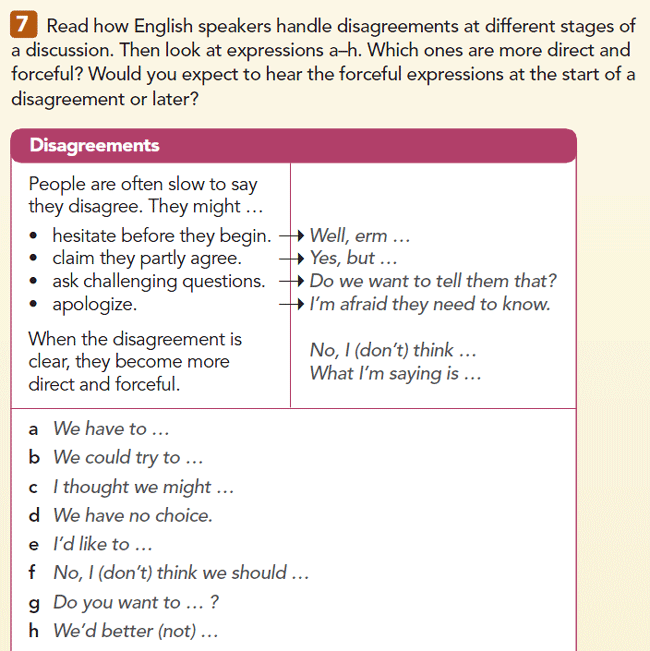
  3. because we’ve got adjacency pairs, the students get to see the responses alongside. We can still ask questions about form like ‘which suggestion form is followed by –ing’, just as we might with a traditional phrase list. But there’s an in-built benefit to the adjacency pairs – they allow us to compare some different strategies folks are using when they respond.  It’s pretty easy to agree with someone else’s suggestion – no threat to face there. Disagreeing is trickier and we commonly employ strategies like hesitating, questioning, or changing the subject. If we list adjacency pairs rather than single phrases, we can ask the students follow up questions about what strategies the speakers are using when they respond, and to compare the strategies to those employed in their own language.

And onto my second example. The idea here is that what we say is one thing, but when we say it is another. What’s appropriate at one time may be inappropriate at another. So here’s a traditional list, but with some basic usage information added.

It gets easier to discuss speakers’ intentions, politeness issues and discourse as students advance in level, but I don’t see the sense of waiting until students are high intermediate or advanced. Both of these examples come from Lifestyle pre-intermediate (Copyright Longman Pearson 2010).

But there’s a paradox here, because in some ways it flies in the face of what we might see as good teaching practice. This isn’t a ‘learning-by-doing’ method. There’s explicit instruction going on here about usage before we go into a role play or or whatever.

There’s a pretty general consensus in the pragmatics literature that we should teach features of discourse more overtly – so point them out and raise them for discussion. Research evidence suggests we can’t necessarily expect our students to pick up the social rules speakers are following in the same way that they might pick up new vocabulary or grammar structures. I don’t think we can impose our social rules on our students, but I think we owe it to them to tell them what they are, so they can make informed choices.

Also, in both the examples above, the phrases are demonstrated in use in a longer listening text. That’s not going to work in a dogme-style lesson based primarily around student input. It’s another challenge and I hope to post on that another day…

You might also want to check out my posts on:
How about some nice
How about some nice
Scrapping the lists
Some list alternatives 2

And for more on pragmatics and sociolinguistics, check out my Learning to speak ‘merican blog which explores how meanings get conveyed (or not) in greater depth, along with issues like politeness and directness.
 Posted by at 5:38 am
Mar 182010
 

Here’s an example of the kinds of functional phrase lists I used to teach with and write:

But for some years now, I’ve been tearing them up and hunting new alternatives. Why? Well, they just don’t seem logical to me.

It’s not so much what’s in the lists that bothers me. I think we can fix a lot of  that these days with good corpora. But even with high frequency phrases from well suited corpora, I still have a problem with the lists. I just don’t like the way the phrases are extracted from their context. 

Now if it’s grammar we’re teaching, I can sort of see how it’s a different matter. Isolating phrases might help if we want students to look at a structure and see how we can manipuate it. But when when we’re teaching speech acts like agreeing, disagreeing, greeting, requesting, inviting, etc, we need to be imparting usage information.

Think of all the times you’ve dished out lists like the ones above and told your students to use them in a role play. And then think of all the times you’ve winced when you’ve heard them use them inappropriately.

I can’t see a way to solve that problem if we extract phrases from context. Something pretty fundamental about conversation is it’s co-constructed. You can’t have one on your own, unless you’re like my ‘merican dentist. Maybe you remember him? Here’s a story about him that I blogged sometime back:

speaking

My dentist works in a tall building at 15th and Market in Philly. He got in the elevator one day and there was another passenger already inside. They didn’t know one another, but they made eye contact and acknowledged each other.

As he hit his floor button she said ‘I can’t believe it’s still raining’.

‘Yes, it’s terrible’, he said. ‘Really bad’.

‘When’s it going to stop?’ she said.

‘Well, the forecast’s not looking too good’

‘So, is it going to affect your plans?’

‘Yeah,  we were thinking of going to the shore this weekend, but I don’t expect we will now.’

After a few more turns he arrived at his floor and stepped out. As he left, he noticed his fellow passenger was wearing a cell phone earpiece. She had been talking to someone else but he had been answering all her questions.

We’ve got 3 sets of adjacency pairs here, where someone says something that demands a response from someone else. Adjacency pairs are the building blocks of conversation. If I say ‘How are you?’, then you have to say ‘I’m fine thanks’. And you can deviate a bit, and say ‘Not too bad’, ‘Could be better’ or even ‘None of your business’. But there are limits to how far you can deviate without me thinking you’re a bit weird. And if you don’t answer – well,  that will mean something too.

So I reckon there have to be better ways to illustrate how speech acts work. For me, it’s out with the lists and in with adjacency pairs and longer tracts that can demo how conversations develop over time. And I hope I’ll find more ways as I carry down this path, and maybe some of you are trying to do something similar?

So any thoughts anyone? Am I throwing a baby out with some bath water? And if not, any good ideas on how to bury those lists?

You might also want to check out my posts on:
How about some nice
Some list alternatives 1
Some list alternatives 2

And for more on pragmatics and sociolinguistics, check out my Learning to speak ‘merican blog which explores how meanings get conveyed (or not) in greater depth, along with issues like politeness and directness.

Image by Ilco

IATEFL conference 2010

 Posted by at 5:12 am
Mar 142010
 
I came across a video when I was hunting for material to use with the COO of a chain of Brazilian shopping malls. It proved so intriguing, that now I sometimes show it to other students, if I can find a way to work it in. So here it is - a contribution to the ESL/EFL Carnival of Lessons. If you have any ideas for extending it, please share. It's for upper-intermediate students.


Clicking on the picture of the shopping mall to the right will take you to the video.

(Viewers in the UK  may find they hit a copyright block, but they can find something similar here. UK : http://www.youtube.com/watch?v=S1f_o7xgvl8

Thanks for that link Laura!)

When your students have watched it, ask the logical question: how did he do it?

Students unfamiliar with Derren Brown may have difficulty believing it’s for real at first. You can assure them it is – or ar least, as I understand it, it really did happen.

OK, onto the dictation task. Explain to your students that they’re going to listen again and find out what he said. Then hand out the text below. Derren said something similar, but not quite the same. Their task is to spot the differences and make a note of them.

Good afternoon ladies and gentlemen and welcome to the Pallisades Mall. We hope that your shopping experience is an uplifting one and I’d like to bring to your attention some very special offers today. Details of our special offers can be found by the elevators, so why not come right on up and see for yourselves. Our special offers will only be available for a short period of time, so all those customers wishing to reach out and grab this exciting opportunity should do so now.

For your reference, here’s what Derren actually said. Embedded (in CAPS) are hidden commands.

We hope that your shopping experience is an UPLIFTING ARM, and I’d like to bring to your PAY ATTENTION some very special offers today. Details of our special offers can be found HANDILY by the ELEVATORS, so why not come RIGHT ARM UP and SEIZE for yourselves. Our special offers will only be available for a short period of time, so all those customers wishing to REACH UP and GRAB this exciting opportunity should do so NOW.

So now your students are looking at what Derren Brown actually said: how do they think he did it?

The answer? Well, goodness knows really, but it seems shopping malls put us into some kind of trance where we become susceptible to subliminal messages. He mentioned at the start that:

  • the recording was prerecorded and played throughout the shopping centre for about half an hour
  • shopping malls are ‘the perfect place’ to find a large number of compliant people

Derren often seems to raise his voice for the embedded commands, and there’s a call to action in his final sentence – so he’s not just telling the shoppers what to do, but also when to do it.

(Sales people may be familiar with that technique.)


For a printable classroom worksheet with some vocabulary help and possible discussion questions, click here.

And if your students want to see more Derren Brown, they’ll find lots more to watch at youtube. For example:

Subliminal advertising      Paying with paper       Winning on a losing ticket Part one and Part two

 Posted by at 9:59 pm
Feb 132010
 

The hard dish installs the manual by alistairmcmillan.

Technical manuals are clear, direct and precise, right? The content is factual. There’s going to be none of the pussy footing around and ambiguity that we’d associate with the ‘polite’ stuff that folks (like me)  usually write about, right?

There’s a great research paper here on ‘simple English’ that illustrates just how wrong these assumptions are.

Operating manuals contain a large number modals verbs

You must do an inspection of all the tubes

The handle should be folded inside the stabilizer trim

‘Should’ differs from ‘must’ in terms of the expectation of compliance – how confident we feel that it’s going to happen.

You must inspect it (and I think you will because I have told you to)

You should inspect it (It’s the right thing to do but perhaps you won’t)

And then there are some more ‘fuzzy’ modals like ‘may’ and ‘can’.

Use of long range cruise may be appropriate

Mercury vapors can be toxic

Something interesting about ‘may’: if I say you may do something, it also implies you may not. It suggests that I am not fully committed to the instruction, so if it turns out that it wasn’t appropriate to use long range cruise, I can’t be held responsible. And there’s a similar lack of commitment if I say ‘can’. In some way, I’m less responsible for the outcome.

Macintosh User Manual - Chapter 1 by peterme.

The language of technical manuals aspires to be plain, straightforward English, so we might expect that all manuals would be similar in their use of these modals – irrespective of their audience.

They’re not. The study shows that operations manuals written for high status pilots, have fewer uses of ‘must’ and many more uses of ‘should’, ‘may’ and ‘can’. In repair manuals written for lower status technicians, there are more uses of ‘must’.

Why?

Like the authors of this study, I reckon that it’s about status. I can’t see another sensible explanation for the disparity. We might like to imagine that technical language is socially neutral and free of fuzziness, but in practice, that’s not the case. Writers of manuals attend to politeness issues – like the rest of the human race – and if they are writing in Anglo-English, they will attend to a social requirement to pretend like the other person has a choice.

And I’m not suggesting that this is good practice or bad practice. I’m just saying it exists. And I think that if these politeness issues are there, we need to address them and teach them – to everyone, including (and maybe especially) our techie students. All thoughts welcome, so please chip in if you have ideas on this.

Other postings related to this that you might be interested in:

 Posted by at 8:21 am
Feb 082010
 

Before I talk about my latest faux pas, a word about the E4BT (English for Business and Technology) conference in Brunei.  It’s a unique mix of terrific teaching ideas from South East Asia, an abundance of exotic food and Brunei hospitality – all coming together to make it the friendliest conference I’ve ever known. Truly heart warming. It may become a biannual event so if you get a glimmer of a chance, go for it! 


And you also get treated to Ritual (intentional capita R). There’s an opening ceremony, a closing ceremony, and a farewell dinner and lots of food in between.  Amongst other things, the opening ceremony includes drums, honoured guests, a very honoured guest, a gong, speeches, fresh flowers, a prayer, lots of press and a master of protocol.

I totally screwed up on the protocol. I  mistook my cue and leapt up and spoke ahead of time, throwing the whole order of events out of sync. Ah my. Dismay and consternation. Unknowingly I’d usurped the very honoured guest position and caused embarrassment left right and centre. Argh! And the irony was – I was speaking about ‘politeness theories’.

Notes to self: ‘Take it easy’. ‘Wait, wait, and wait until you are sure you have been called upon’. ‘Go say sorry – thankfully people can be very forgiving’. ‘E4BT is definitely one to return to if you can.’

 Posted by at 5:00 am
Jan 292010
 

It’s a place where:

  • handshakes are gentle
  • you use all four fingers of your right hand palm down to beckon.
  • you used to be able to listen to Captial FM on the radio, so you could drive along at night, hearing about early morning traffic jams on the M25.
  • one travellers’ guide I just read recommended containing any sudden urges you might have to kick up a rumpus immediately after sunset on Thursday evenings.

And here’s your picture clue:

brunei reflection by tylerdurden1.

Answer: I’m in for a treat, because next week I will be visiting the beautiful Brunei, a Sultanate on the northwest coast of the Island of Borneo. I’ve been once before, and remember it encountering some delightfully exotic customs and rituals.

That travellers’ guide also said:

 “If sent an invitation, you should arrive on time or within 20 minutes of the stated time”.

 But I remember it as being more complex than that. Lower status conference attendees arrived early, then the more important ones came a bit later, then the VIP’s and then the very big VIPs were the last to arrive. With no written rules to guide them, folks understood their place in the pecking order and schedule and timed their entrances to precise perfection.

I messed up one evening. I mistook an invitation as being a sort of casual ‘come any time’ suggestion when it wasn’t. I found myself arriving at a formal dinner after the big VIPs. Big blushes. Who did I think I was? To make up for my faux pas, I thought I should mingle for a while after dinner, until a European lady realized I was a rookie and whispered in my ear: ‘You realize nobody can go home until you have left’. Horror of horrors! Behind me was a row of my hosts, standing in line to shake hands and bid me farewell.

Luckily they seem to have forgiven me (or perhaps tactfully chosen to forget?) because they are letting me come back. So if you’re free and in the neighbourhood this weekend, please come and say hi at the E4BT (English for Business and Technology) conference at the Institut Teknologi Brunei, Brunei Darussalam. And if not, I hope to return with some stories to tell.

If you fancy some more cultural oddities reading while I’m gone, I bet you’ll enjoy the lovely new politeness worksheet over at Alex Case’s blog. Now I must go pack. Luckily Lyndsay Clanfield has vlogged some tips on that.

 Posted by at 10:44 am
Jan 032010
 

Mars et Venus by AndyRob.If you’re a company or government agency and your organization is having some communication problems, who do you call for help: a management consultant, or an occupational psychologist perhaps?

I’ve just come across a paper by Joanna Channell explaining why a linguist might be a better bet. She provides concrete examples of  valuable help linguists have provided using approaches such as needs analysis, genre analysis, pragmatics, conversational analysis and corpus linguistics.

You need to scroll down to page 13, but the paper is freely available on the web as part of the University of Surrey’s 2003 Language for Special Purposes conference proceedings.

Joanna notes a culture gap between Language for Special Purposes practitioners and non-linguists:

Helpfully, she also suggests ways we might bridge the divide. Her advice seems very transferable to business English trainers, consultants and schools pitching to clients to me too. And as Joanna aptly puts it:

I believe there is a need for a major international effort to raise the profile of applied linguistics and within this, the LSP [Language for Special Purposes] perspective. Currently much organisational consultancy is carried out either by people applying psychology or applying management sciences. I am clear that applied linguistics has a legitimate and needed place alongside these two.

 Posted by at 6:49 pm
Dec 182009
 

justdoitWhen is a suggestion just a suggestion, and when is it a request or an order? So if someone says it’s a good idea to do this or that, can we be sure they are just throwing out an idea, or might it mean they are asking or telling us to do it?

Presumably the answer can depend on things like whether it’s our best friend or boss making the suggestion, and it’ll vary from context to context.

When we want to talk about the different forms we might use to get someone to do something in an English class, we can run into problems. Descriptions may involve words like ‘direct’, ‘indirect’, ‘imposition’, ‘polite’, ‘consideration’, ‘formal’ and ‘informal’  and they don’t have universal meanings that match in all languages. Each one comes with some of our cultural baggage attached.

 Enter Anna Wierzbicka. She advocates using ‘semantic primitives’ to explain and compare meanings – so limiting ourselves to words that we know have shared concepts in all languages. Here’s how Anna compares ordering, asking and advising someone to do something using semantic primitives.

semanticprimes

Source: page 202 of Cross-Cultural Pragmatics: The Semantics of Human Interaction (Trends in Linguistics: Studies & Monographs), Mouton de Gruyter, 2003 by Anna Wierzbicka

The idea is that with descriptions like this and lots of different contexts (so here, it would be lots of different situations in which different folks might order, ask and advise) we can compare what we’d say in different languages and discuss cultural differences without misunderstanding. She’s so utterly logical and it’s a brilliant book. I just wish there were more semantic primes we could use. See here for a list.

 Posted by at 7:37 am
Dec 132009
 

How About Some Nice by Your Pal Dave.

A lot of my students seem to think we make suggestions by saying, ‘I suggest…’ Similarly with proposals and recommendations, they seem to think ‘I propose…’ or ‘I recommend…’ is what we say. They’re perfectly logical. The only problem is of course, we’re not.

In practice we generally use those verbs to ‘talk about’ suggestions, rather than actually make them. So in speech data they seem to show up in contexts where we want to be explicit. We might use them to clarify something:

Are you suggesting that…?

Or to signal something we’re going talk about:

We’d like to propose a different solution…

Or we might use them to report what someone else has said.

They recommended we change the plans.

They often seem to crop up in conflict situations where somebody is trying to be precise and formally go on-record about what’s being said. But when we’re involved in friendly collaboration, more tentative expressions like ‘How about…? or ‘What if we…?’ or ‘Why don’t we..?’ are more likely to pop out of our mouths. (Pretending like other people have a choice when they don’t really seems to be a feature of anglo English.)

The phrases ‘I disagree’ and ‘I don’t agree’ are similar and they rarely come up in native speaker workplace conversation. My students, on the other hand, say them a lot, along with that another famous line: ‘I am not agree’. That one we react to because it’s ‘ungrammatical’. The rules are much clearer for written sentence grammar.

Getting that grammar wrong means someone doesn’t know the language. So if someone says ‘I am not agree’ we understand their English is dodgy and make allowances. The potential for relationship damage is limited. It’s when they get the social rules wrong that things get tricky. We think they might have ‘a difficult personality’ and they go on probation while we try to figure them out.

We seem to say ‘I disagree’ when we want to be explicit, perhaps to clarify when there’s a misunderstanding:

No, no. You don’t understand what I said. I disagree with that idea.

Or to report what someone else has said.

Toby doesn’t agree with us.

By way of contrast, we seem to accomplish agreement pretty easily with a quick ‘Good’, ‘Right’, ‘Yeah’ or whatever. There’s no potential for relationship damage there. It’s the disagreements that challenge us. So at the start of turns we might hesitate, (Errr… well…) claim partial agreement (Yes, but…), ask questions (How much will that cost?) or change the subject and suggest something completely different instead (So does anyone feel like a cup of coffee?)

If I were learning English, I think I’d want to be perceived as a decent and likeable sort of person and relational stuff like this would be pretty important. So how about it?  Is it time to rethink how we teach functions like these?

For some practical ideas on how to do this, see my posts on:
Scrapping the lists
Some list alternatives 1
Some list alternatives 2

And for more on pragmatics and sociolinguistics, check out my Learning to speak ‘merican blog which explores how meanings get conveyed (or not) in greater depth, along with issues like politeness and directness.

 Posted by at 7:26 am