Vicki

Teacher of professional and technical English, writer and teacher trainer.

Sep 092012
 

I love teaching with video and find I avoid taking audio materials into class these days. Luckily blogs with creative video lesson ideas have been blossoming on the web, and so have sites that we can send our students to for out-of-class viewing. This is a very incomplete list because there are so many, but here are some of my favourites:

Videos for watching in class with lesson ideas:

  • Jamie Keddie’s Lessonstream – Jamie now has more than seventy lessons. Do check out his demonstrations of a technique he calls video-telling if you haven’t already.
  •  Kieran Donaghy Keiran’s a shorts fan, which ironically means he tends to focus on longer videos.  Again he has some great lesson ideas.
  • Designer Lesson Ideas is a group blog that includes non-video lessson too, but  many employ video creatively so I’m including it here.
  • In amongst other stuff  TheTeacherJames also has some nice video lesson ideas.

Videos for students to watch out of class:

  • As I’ve mentioned elsewhere, I’m a big fan of English Central because of the  variety of videos on offer. Another site with a wide range of motivating videos is English Attack. Both these sites provide gapfill and dictation tasks. English yappr takes dictations to another level. It has an ingenious system where creating a transcript becomes a group task – very motivating, I’d imagine. It also has ‘clear voice’ button’ and British listeners may be tickled to discover that that means British voices can be replaced with ‘merican.
  • ESL videos has videos submitted by teachers who also provide comprehension questions. Personally, I’m not a big fan of the multiple choice Qs but thought it worth a mention because it has one of the largest collections of videos I’ve seen. You can submit videos there yourself if you like.
  • Real English has been a pioneer in vox pop recordings made in the street and usefully for lower levels, the videos are graded for difficulty.
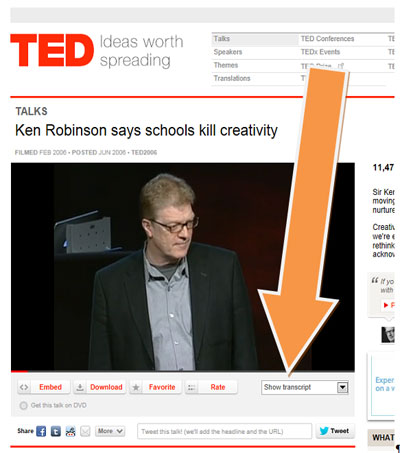
  • We mustn’t forget he wonderful TED site which has stacks of fascinating presentations on a wide variety of subjects. (Remember to show your students how to use its clickable transcripts.)
  • And of course there’s also my new site, Simple English Videos , where students can watch the latest movie trailers supported by clickable transcripts, a learners dictionary and google translate. Click here to see and article I wrote about it on Teaching Village which has some homework tasks.

    I hope others running video sites (which I know isn’t easy) will forgive me for missing them out. Space and my memory have been the issues. Please pass along other links in the comments. Also, I’m aware that there are some terrific young learners video sites around and I’m hoping others more experienced in that field can fill us in on those.

    So which sites are your favourites? Please tell me!
     

 Posted by at 9:01 am
Sep 042012
 

‘Rubrics’ seems to be a word that’s generally used differently in British and ‘merican. In British English (as I understand it) we generally use it to refer to the written instructions you find in textbooks. In ‘merican it’s the marking criteria for tasks and assignments.

I’ve never been a fan of long rubrics (in the British sense) and have always admired authors who can keep them short and sweet. But if the rubrics can be videos, then I feel rather differently about them. Here’s a discussion lesson that my business English students have enjoyed and found useful where the rubrics are delivered via video of a somewhat frazzled boss. I think it’s pretty self explanatory, but do drop me a line if you’d like more guidance on how it works. And if you use it, please tell me how it went.


 Posted by at 10:32 am
Aug 282012
 

A good story has lots of elements but essentially it’s going to have a lead character we care about who is facing some kind of challenge or problem. And the plot is going to keep moving – that’s really important. It has to have ‘rising action’ as Aristotle would say, all the complications of the plot that build up to the climax. So there are universals at work in a good story.

Movie trailers are condensed stories – designed to tantalise, tell us just enough to make us care about the characters, and then leave us on the hook wanting to know more. They’re a great source of input for lessons for many reasons including:

  • not too short and not too long
  • natural conversation in context
  • an unknown ending so we can discuss what might happen

And the universal features of a story provide us with comprehension questions we can use again and again, with almost every trailer.

  1. What genre of movie is it? e.g horror, action, romantic comedy…
  2. Who is the hero?
  3. What problem or challenge are they facing?
  4. What other characters do we see and how are they related to the hero?
  5. What happens to the hero?
  6. Do you care about the hero or not? (Why?)
  7. How might the story end?
  8. Do you want to see this movie? (Why/Why not?)

Click here to download a free worksheet that works with practically every movie trailer. And click here to visit my new Simple English Videos website which has 34 of the latest movie trailers to choose from, plus clickable transcripts. I’ve been thrilled to find the site is attracting visitors from all over the world and I’m adding new videos almost every day. If you have any tips or suggestions for the site, please pass them along.

To get updates on new videos as they are added, follow me on Twitter here:


 Posted by at 6:08 pm
Aug 212012
 

What kind of business skills courses do you pitch to clients: meetings, presentations, negotiating, report writing perhaps? What about a course  in story telling?

I love it when I get to prepare students for a story telling course at the Wharton school. Not only do I get to hear some ripping business yarns but I also get to feel really useful. It gives us the opportunity to focus on discourse and develop skills they can start putting to use right away.

We’ve all encountered people who’ve had difficulties structuring stories. Perhaps some important element has been missing, or they get the length or timing wrong, or they just seem pointless. The pay off matters particularly, in  business English contexts, I think.

So story telling seems like such a valuable business skill to me.  If you need to make complex ideas comprehensible, ignite organizational change or build a sense of community, stories are great places to start. Stories can teach, inspire, motivate, convey values – all essential leadership skills.

So instead of reaching for the meetings and presentations courses, how about some story telling?


 Posted by at 3:27 pm
Aug 112012
 

Video is such a motivating medium for English learners and a fantastic resource for the flipped classroom. But it has limitations if we want to send students off to watch something on their own. What can they do if they can’t understand a word or phrase and we’re not around to help? And how can they find out what things mean if they don’t know where one word stops and another starts?

But that was yesterday. Today we can have:

  • clickable transcripts
  • online learners dictionaries
  • translation tools

My students’ eyes light up when they see videos that have clickable transcripts. They give them instant and precise control over how the video plays. And there’s no more frustration if they don’t understand because they can check words and phrases in a dictionary, and even translate a whole script if they need too.

And that’s what my new website is all about.

We’re starting with 24 movie trailer videos and there will be new ones every week. There are comedies, thrillers, music movies, dramas – something for everyone. So rather than ‘presentations-genre’ English such as those at the wonderful TEd.com, this website provides ‘conversation-genre’ videos.  Oh, and did I say it was free? Yes, it’s totally free!

I’ve set up a different Twitter account that’ll announce new content as it goes up. So please tell your students to follow me posting for Simple English videos as @VickiVideos. That way they’ll catch the latest movie trailers. And tell them to comment on the videos at the site too. I’ll be responding.

And please let me know what you think of the new site too. All tips and advice will be gratefully received.

 Posted by at 9:41 pm
Aug 112012
 

I find it tricky to schedule the weekly twitter meetings of #ELTchat, plus I find Twitter’s character contraints a bit of a challenge. However, I am a firm fan of #ELTchat’s ever growing library of discussions. What a wonderful resource for teachers!  It seems #ELTchat is moving to a new home. Here’s a post by Marisa Constantinides that explains what’s happening. Over to Marisa:

For the last – well, almost two years now, since September 15 2010, #ELTchat has kept us on our toes and forged hundreds of professional and personal relationships amongst its followers who turn up on Twitter every Wednesday to talk about topics they have suggested and voted on – a community of peers which was created by a small group of colleagues – which grew and grew some more and became something that counts as an important part of our continuous professional development.

Like many great ideas, it didn’t hit just one person but several.

And that is how #ELTchat was created.   

The website to keep up the communication of its members, a base and repository of our ideas was one of the first things we all thought of creating – the wiki came later. Andy Chaplin was keen to join the moderation team and help with podcasts and technical stuff; he was quick to buy eltchat.com and announced the good news to us after the fact.

A few months later, right after TESOL France 2011,  he suddenly disappeared – some say for reasons of health.

We never found out for sure. We never received a single word of response to our emails.

eltchat.com was and still is registered in his name.

And yesterday we lost it

On August 8 the domain expired and we have no way of taking over unless it goes up for sale again; it was very sad that Andy Chaplin did not find it appropriate to renew.

The news is really upsetting.

The work we have put in on this website cannot be told in a few simple words – but it has been a labour of love and we have got so much out of it that we have never regretted one single moment

We are pretty upset at the behaviour of this individual – disappointment is one big understatement.

But we trust that our community of #ELTchatters, our PLN for short, will again gather round the new domain which we have purchased – eltchat.org It will take us a few days to put the website back on its feet

And all will be as it was before – all the posts in place all your thoughts and comments, all the polls and great summaries which got us on the shortlist of the ELTon Awards nominations

We will be back with a vengeance

We are not just a website – we did not get on the ELTon awards shortlist as just another website!!!

We are a great community of teachers and we have a Plan B!

See you all in September!!!

Marisa Constantinides – Shaun Wilden

Bravo Marisa, Shaun and everyone involved. I look forward to seeing #ELTchat go from strength to strength – Vicki Hollett


 Posted by at 9:35 pm
Aug 072012
 

Test scores are sometimes poor representations of someone’s ability to communicate. I think many English teachers have come across students who would come out at say lower intermediate or B1 on a scale, and yet they’ve been able to communicate their ideas effectively – powerfully even – more so than many upper intermediate or B2 students. It’s always intrigued me. What are they doing that’s working so well? If we could bottle it up and pass it around we’d be able to solve a lot of problems for a lot of people.

Now obviously it might be about things we can’t teach like personality, intelligence… But I reckon there are other things going on too that we can help all our students with.

A lot of it is about the structure of ideas. Those able communicators are structuring their thoughts in ways that other people can easily follow. Often language teaching focuses on what happens at a word and sentence level (and that’s often what gets tested too). But what if we shifted our attention more to how ideas get structured over longer tracts of discourse?

Now of course some approaches have always done that. Genre approaches in ESP spring to mind and structure often crops up in business presentation courses. An area where discourse structure is really important is story telling.  As Aristotle explained….


Does storytelling feature in your English courses and would you like it to? And what other things do you do that focus attention on text organization and discourse?

 Posted by at 8:00 am
Aug 042012
 

It doesn’t matter whether you have a three year olds climbing on their seats or a class of businessmen fixated on their email. “I want to tell you a story” captures attention.

And if you then take a conspiratorial look over your shoulder, lean forward, curl your forefinger and say “C’m here”, they’ll all lean forward in their seats.

You’ve got ’em hooked.

So now what are you going to do?

It’s time to employ the ancient art of storytelling – an art that dates back to the ancient Greeks and beyond. So what makes a good story?

What elements does a story need to keep your students gripped?


 Posted by at 2:48 pm
Aug 042012
 

There’s never been a better time to learn English. You can connect with other learners on community sites like English Club and Livemocha, and there’s so much good video content around. I’m a big fan of sites like English Central, and englishyappr which have stacks of entertaining videos that are bound to motivate. And then there’s the glorious TED site with riveting talks by international experts.

Now there’s something interesting about TED talks that my students often don’t know about. Many have interactive scripts, so if you click on the transcript button, you can control the videos. It’s a powerful tool for a language learners because it lets them jump forward and back and choose what sections they want to hear again.

It recently became possible to do a similar thing with youtube videos if they have captions, but it’s a bit of a fiddle there. I prefer the elegant TED layout better and for a good while I’ve hankered after having such a tool for videos I make or use.

Well, guess what! After a good deal of trial and error, we’ve worked out how to do it! So watch this space for news of my latest project. We’ve been building a cool new website for learners with engaging videos, opportunities to connect and yes, clickable transcripts!

Does it sound appealing? And what video sites do you and your students enjoy?


 Posted by at 4:59 am
Aug 022012
 

If  human beings communicated like most ELT course book characters, the world would be a much simpler place. There’d be next to no hedging or vague language or ambiguity or politeness strategies. Everything would be very literal. We wouldn’t have to consider issues like context, culture, power or gender and how they might affect meaning. In fact we’d just have to focus on getting our grammar and vocabulary right. That’s how course books generally work. If the grammar and vocabulary is correct, the message gets understood.

What a curious world it would be. No differing interpretations. No shades of grey.

I’m not having a go at ELT course books here. A good syllabus needs to transform the sprawling messiness of  the English language and make it into something managable and learnable.  To some extent writers have to simplify. Taking a black and white perspective on communication is one way to do that. And it’s easier to include the answers in the back of a book if there’s only one correct alternative.

But I do think we have to be aware of it and compensate. We shouldn’t be implying that if the grammar and vocabulary is correct, all will be well. It’s just not true. Human beings are often indirect, and they often have good reasons for being ambiguous. So rather than presenting models of language that ignore ambiguity, I suggest we present examples that explore it.

And that’s what the lesson below is about. It’s based on some research that readers of this blog kindly helped me with some time back. Click on the picture below to start the program. Hope you and your students enjoy it and find it useful.


To see the original research question: click here. Please comment or hit the ‘like’ button and let me know what you and your students think of it.

What’s your take? Should ambiguity be explored in the ELT classroom and if so why and how?


 Posted by at 5:00 am