We put Carter to work for this week’s video lesson.
The rules for adverbs of frequency are actually very complex, so we kept to the basics here.
Hope you like it!
We plan to start free live classes this autumn/fall – very exciting! Click this link and subscribe to our newsletter so you get emails with the schedule.
https://www.simpleenglishvideos.com/subscribe/
Follow us on twitter as @VickiVideos so you don’t miss out on future videos. http://twitter.com/VickiVideos
This week’s new lesson is one I’ve been wanting to do for AGES! We have remade our lesson on ‘raise’ and ‘rise’, adding new scenes and a fuller grammar explanation. Hope you like it!
Knowing how to combine like with sense verbs is a jolly handy thing to know in English. In this video we start with ‘look like’ and teach the basic pattern. After that – well hopefully your students will be set up to use ‘like’ in lots more expressions.
Tag is a kids game where one person is ‘it’ and they chase after and try to catch the other players, but it’s not easy because the other players are all running away. And that’s how telephone tag gets its name. It describes those situations where people try to communicate by telephone but continually miss each other.
Telephone tag is a great context for teaching English for voicemails. Check out our latest collaboration video and subscribe to the teachers who helped make it so you don’t miss out on their future lessons.
JenniferESL, Gabby of Go Natural English, Minoo of Anglo Link, and Fluency MC (Jason Levine).
Make sure you subscribe to everyone’s channels:
Jennifer
YouTube: www.youtube.com/jenniferesl
Facebook: https://www.facebook.com/englishwithjenniferlebedev/
Twitter: https://twitter.com/JLebedev_ESL
Website: http://www.englishwithjennifer.com/
Blog for teachers: https://englishwithjennifer.wordpress.com/
Follow me on twitter as @VickiVideos so you don’t miss out on future videos and don’t forget to subscribe to our YouTube channel too:
YouTube channel: https://www.youtube.com/user/vickihollettvideo
Facebook Page: https://www.facebook.com/SimpleEnglishVideos/
Twitter: @vickivideos @vickihollett
Mailing List Sign up: https://www.simpleenglishvideos.com/subscribe/
Website: http://simpleenglishvideos.com http://www.vickihollett.com
I’ve written about EFL and copyright before. It seems only sensible to give creators their due and avoid getting sued for stealing stuff. Crikey – who wants to steal stuff? Isn’t it just common sense?
Well yes, but actually copyright law is also pretty complex and understanding the basics can be quite a challenge.
So here’s a great video from The Consultants-E that explains the basics. A big thank you to Gavin Dudedney and Nicky Hockly for helping to make us all more digitally literate.
Make Friday the thirteenth a lucky day with a lesson on superstitions!
Superstitions are a rich topic for the EFL/ESL classroom. Some teachers use them for controlled practice of ‘if’ statements. E.g.
If you break a mirror, you’ll have seven years of bad luck.
Others use them for discussion practice and cultural comparison. You can do either or both with this lesson.
It’s a video lesson with two parts. First there’s a conversation that will warm students to the topic and check the meanings of the words ‘superstition’ and ‘superstitious’. You might want your class to act out the conversation after watching it. And the second part of the lesson comes in the form of a song which has a built-in puzzle.
The other day I noticed that Google had cleared permissions for Stevie Wonder’s terrific ‘Superstition’ song on YouTube. Wow! What a great opportunity for a puzzle! So I’ve made a video that’s packed with images of different superstitious events and objects, and the students’ task is to see how many they can spot. You might want to set up competing teams so they watch the video and see which team can spot the most.
The video is designed to prompt lots of discussion and the advice in the song is very sensible and clear: don’t believe in superstitions!
Here are some things students will see:
Situations where people often get superstitious
When gambling
When they see a fountain. (People often throw a coin in and make a wish.)
At weddings (What colour do brides wear? Do they have ‘something old, something new, something borrowed, something blue?’ Do they throw the bouquet to find out who will get married next?)
Creatures
Black cats – If a black cat crosses your path, does it bring good or bad luck? The answer seems to vary.
Spiders – Finding a spider on your clothes is sometimes said to be lucky and killing a spider is often frowned upon. ‘If you wish to live and thrive, let a spider run alive.’
Snakes – As well as being associated with voodoo, there are lots of superstitions surrounding snakes. For example, hanging a snake from the rafters is supposed to protect a house from fire.
Lady birds (AmE: Lady bugs) If a lady bird lands on you, some say you shouldn’t brush it off. Instead you should count the spots to see how many years of good luck you’re going to get.
Flowers
We get a fleeting glance of chrysanthemums in the video which seem to have a lot of superstitions attached in different cultures. But other flowers do too. Are there flowers you’re not supposed to bring into the house? Do you have to present an odd number, unwrapped, when you give flowers as a gift?
Cutlery
Speaking of gifts, it’s unlucky to give knives in some cultures as it’s supposed to foretell the severing of the relationship. Are there other things you should and shouldn’t give as gifts?
Ladders, mirrors and candles
Walking under a ladder is supposed to be unlucky
As Stevie Wonder tells us, breaking a mirror is supposed to bring seven years of bad luck.
Candles have a variety of superstitions surrounding them. For example, if a candle suddenly goes out on its own it can be an omen of death in the family. On the other hand, some say lighting a new white candle in a new house is supposed to bring good luck.
Lucky objects
Some lucky objects in the video include:
a horse shoe (Which way up should it be? Customs seem to vary)
a four leaf clover (or maybe it’s an Irish shamrock – that’s supposed to be lucky too)
a rooster of Barcelos – a lucky symbol in Portugal
a daruma doll – lucky in Japan (we also see a Japanese symbol for luck)
the Chinese character for luck and also a Chinese fortune cookie, which contains lucky numbers.
Numbers
13 is often associated with bad luck, as is 4 in some cultures. Meanwhile 7 is sometimes associated with good luck and 666 with the devil.
Natural events
A new moon – The story goes that if you turn a coin over in your pocket when there’s a new moon, your money will grow
A rainbow – Supposedly there’s a pot of gold buried at the end of every rainbow.
Superstitious Practices
Crossing your fingers
Throwing salt over your shoulder if you spill it.
Voodoo, fortune telling (tarot cards and a crystal ball), psychics, water dowsing (divining rod) and astrology.
We also see Stonehenge in the video, but why it was built is one of history’s great mysteries. Maybe it actually fulfilled a practical purpose, serving as an astronomical clock. Or maybe it was a place for sun worship, crazy rituals and superstitions. What do you think?
The first video is available with a clickable transcript that you can copy and paste on our Simple English videos website. Click here for the link. It is also available on our YouTube channel. Click here for the link.
For copyright reasons, the second video (the Stevie Wonder song) is only available on our YouTube channel. Click here for the link.
If you use this lesson in class and have time to come back and tell us how it went, please do! We’d love to hear from you!
And if you have other favourite songs you like to use in class, please tell us which ones. You never know. Google might have cleared permissions so I can make another video.
Last year I was lucky enough to have a short one-on-one consultation with someone from YouTube about my channel. “Oh it’s an ESL channel”, he said. “You do realise that’s very niche”. English teaching dominates my world, but of course in the much wider world of YouTube, he was absolutely right. The big topics are things like gaming, music, fashion and lifestyle and English teaching is very niche.
I think it has enormous potential for growth though. There are so many people needing English around the world who don’t have access to a teacher, and video is such a great medium for learning a language because you can see it being used in context.
Next week I’m having another consultation with YouTube and a whole load more because Simple English Videos has just won one of YouTube’s 2016 NextUp Creator Awards. YAY! I’ll get a weeks training in production techniques at the studios in NYC, the opportunity to collaborate and capture footage with other winners and $2500 in vouchers for production equipment. (Pinch me – is it really happening?) And that is why happiness is the topic of our latest video.
Students often muddle up the words ‘Travel’, ‘Trip’ and ‘Journey’ – well, it’s not surprising! Many languages have one word to cover the concepts, so why do we have to have three in English?
Here’s a video about how we use these words that includes the key meaning distinctions and grammar differences, along with lots of examples.
But you don’t have to stop there! Why not finish with a song that everyone can sing along to? Here’s a video that explains a couple of words students will find handy when they listen. (It also comes with a homage to Eric and Ernie – two of my favourite British comedians).
And here is the song, which is sung by the wonderful Doris Day. (Not Jay)
Make sure you leave time at the end of your lesson, so your students can tell you about a sentimental journey they’d like to take? Is there a time or place they’d like to revisit? Why? I’d love to know what they say.
Our ‘Travel Trip and Journey’ video is available with a clickable transcript on our website here.
And you can also find it on our YouTube channel here.
The Doris Day song is available only on YouTube. Luckily Google have cleared the rights so we can all use it legally on YouTube, so I’ve put the introduction video on YouTube too so it can work as a playlist. Follow this link to see both videos and they should follow on from one another. First the introduction and then the video.
How do you teach your students to respond to a question like this?
Tea or coffee?
a. I don’t care
b. I don’t mind
When I lived in England, I used to teach my students ‘I don’t mind’. Some would say ‘I don’t care’, and I’d say, ‘Yes, Americans say that, but I’d avoid it because it can sound negative in British English’. But then I moved to the US and discovered that ‘I don’t mind’ is problematic too!
Maybe the best answer in international contexts is something like ‘I’m happy with either’? What do you think?
There are lots of other curious things about the verb ‘mind’ and last week we released a video exploring some of the ways we use it in requests.
Both videos are available with clickable transcripts at our Simple English Videos website.
To watch the video on British and American differences with ‘I don’t care’ and ‘I don’t mind’, click here.
To watch the video on how to use ‘mind’ in polite requests, click here.
There’s so much interest in the US election candidates! This has to be a great time to have a lesson with an American president. So we’ve given our Obama video a makeover and created captions on YouTube and also lesson materials. Here’s a lesson plan (see below) and it comes with a free worksheet that you can download here.
Lesson plan
1. Warm up by asking the students to imagine their phone is ringing. Who would they most like to receive a call from right now?
2. Are there any times they wouldn’t want to take a call? (e.g. when they’re driving, in the shower, watching their favourite TV show.)
3. Play the video.
4. Check everyone has understood.
a. Who called Vicki and what did they want to talk about? (Barack Obama – he wanted to talk about baseball)
b. Did Vicki handle the call politely and efficiently? What did she do? (See if they can recall some of the instructions they saw at the bottom of the screen.)
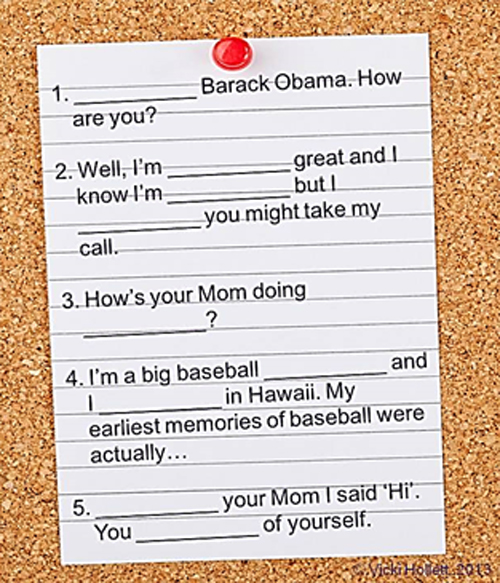
5. Now it’s time to explore the language in more detail. Can they recall some of the things Obama said?
Answers:
This is
doing, interrupting you, figured
these days
fan, grew up,
Tell, take care
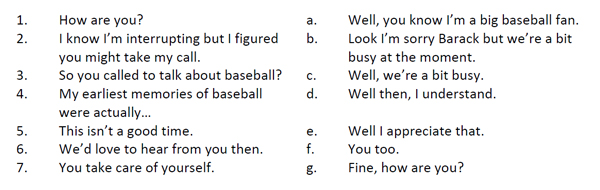
6. Now a matching exercise. You could put these phrases from the video on separate pieces of paper that students can move around, or simply use the worksheet we’ve provided. The students’ task is to match the phrases to their replies.
Answers:
1.g, 2.c, 3.a, 4.b, 5.d, 6.e, 7.f
7. Now it’s time to set up a role play. Ask the students to think of a famous person they’d like to receive a call from. What would they like to talk about with them?
8. Pair the students and tell them they’re going to act out the call with their famous person. Give them a few minutes to prepare what they will say first and then enjoy the fun!
9. To round up the lesson, see if anyone would like to share a story about a memorable phone call they’ve received. Or maybe your students would prefer to discuss who they think should be the next American President (and shouldn’t be President!)